
How Municipal Court Warrants Work
Heard County holds three incorporated cities, and each warrant route stands on its own facts. Municipal courts in Heard County hear city traffic and ordinance cases and can issue warrants inside that jurisdiction. Miss an unexcused appearance and a bench warrant may follow. Ignore a court order and the same thing can happen. Georgia court records sometimes use the term capias, though no Heard source publishes a separate local capias-pro-fine process. The municipal clerk controls the city docket, the next setting, and any order to recall or quash a warrant. Law enforcement handles service and the warrant return. Those roles matter. A county court may truthfully report no file while a city clerk holds the record. City Hall, in turn, may show no county arrest or felony record. Always ask which court issued the process and which agency holds the service return. People often call a failure-to-appear warrant by that practical name. Georgia's uniform citation materials let the court command apprehension and a return to court, with reasonable bond where authorized. Those same materials describe a notice option, but the judge need not wait for it before issuing. Only the local clerk can confirm what actually happened in the city case.
Franklin Municipal Warrants in Heard County
Franklin Municipal Court is Heard County's clearest city-court route, reached through City Hall at (706) 675-6623. Franklin Police sits at 118 Davis Street, (706) 675-6624, with its own traffic-payment instructions. Neither office posts a public bench-warrant search or city warrant roster, so the phone is the tool. The official municipal-court page shows the Franklin contact rather than any private person's case.
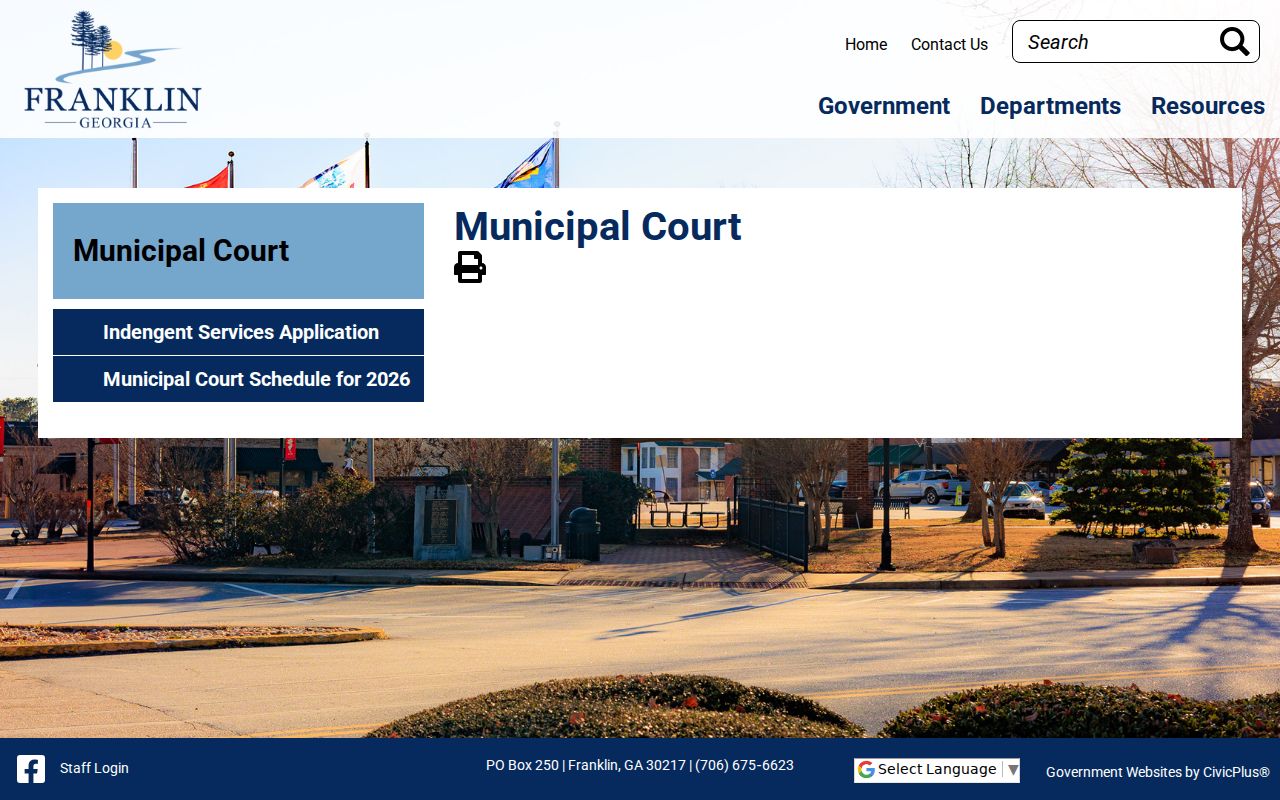
A call to the court clerk can settle the docket, the warrant label, any recall, and the next appearance date. Franklin's citation route may take seven to fourteen days to show a ticket. That posting window is not a warrant deadline. And payment alone is not proof of recall, so get confirmation from the clerk in Heard County before assuming the matter closed.
Municipal Courts Across Heard County
The routes across Heard County differ because no shared municipal portal exists among the official sources. Franklin has a named court contact. Centralhatchee's charter expressly grants warrant authority. Ephesus publishes City Hall contact but no separate current court page. Matters outside the cities belong to county channels, not to any invented municipal court in Heard County.
| City | Court route | Warrant-related role | Phone |
|---|---|---|---|
| Franklin | Franklin Municipal Court through City Hall | City traffic, ordinance, and missed-setting questions | (706) 675-6623 |
| Centralhatchee | City Hall and current municipal clerk | Charter-authorized ordinance warrants, bail, and recognizance | (770) 854-5801 |
| Ephesus | City Hall to identify the current clerk or court | City ordinance or traffic routing; no public portal located | (770) 854-8616 |
On each route, ask the Heard County clerk whether status can be confirmed by phone and which private identifiers the office requires.
Centralhatchee Warrants in Heard County
Centralhatchee's official charter act gives its municipal court the power to issue warrants for town ordinance violations, compel a person's presence, and set bail or recognizance. Recognizance means release on a promise to appear, on whatever conditions the court sets. The charter proves the power. It is not a current warrant list or a procedure manual for this Heard County town.
Start with City Hall; the charter only establishes the municipal court's ordinance authority. Ask the clerk for the ordinance, case number, missed date, current status, and a written next step. Centralhatchee publishes no bond table, warrant line, or surrender plan for Heard County residents to lean on.
Heard County Municipal Warrant Checks
A warrant check starts with the paper. Note the city, the court, the citation or case number, and the hearing date. Have the exact legal name and date of birth ready, but share those details only through an official private channel. No Heard County city offers a verified public warrant name search online.
- Identify Franklin, Centralhatchee, or Ephesus from the citation or notice.
- Call that city's clerk route and ask which court controls the case.
- Ask the clerk for the warrant label, status, issue date, next setting, and recall procedure.
- Call Franklin Police for a Franklin service question or HCSO at (706) 675-3329 for county service confirmation.
- When a warrant is confirmed, speak with the issuing court or a Georgia lawyer before arranging surrender, bond, or an appearance.
Georgia runs no statewide public warrant database. EZ Court Pay searches citation information by date of birth, citation number, or last name, but it is not a complete city-warrant system for Heard County.
Ephesus Warrants in Heard County
Ephesus City Hall, at 24500 Georgia Highway 100 in Roopville, lists (770) 854-8616 and info@ephesus.gov. The official city site posts no separate police department, municipal court page, warrant portal, citation search, bond schedule, or recall form. City Hall should name the current clerk or court for any Ephesus ordinance or traffic question. The official page carries civic contact information only, not a person-level warrant record for this Heard County city.
That civic listing is why a direct call to route you to the clerk beats an online lookup here. The official service plan says Ephesus uses off-duty Heard County sheriff's deputies for policing. HCSO is therefore a logical service contact once City Hall identifies the court, but it is not the municipal docket clerk.
Municipal Warrants: What They Show
No official person-level city warrant sample or local number format is published for Heard County. Georgia court materials still support a field inventory, which helps a resident ask precise questions about a warrant.
| Case or warrant number | The identifier connecting the court order to its city case; request the exact number rather than inventing a form such as CITY-CASE-NUMBER. |
|---|---|
| Offense or ordinance | The city rule, traffic allegation, or failure-to-appear event. |
| Issuing court | The municipal judicial officer and city court controlling the order. |
| Appearance and notice | The scheduled date, any missed setting, and any reschedule or notice entry. |
| Bond or condition | Any court-set amount or release term; no countywide city schedule exists. |
| Status and return | Active, served, recalled, quashed, or another court status plus available service information. |
Ask the Heard County clerk for the date of the current status and written proof after any recall or new setting.
Heard County City Warrant Service
Franklin runs its own police department in Heard County. Centralhatchee and Ephesus take a different route, contracting with off-duty sheriff's deputies for policing under official service records. Courts still issue the warrants either way, and clerks keep the docket.
| Question | Best first source |
|---|---|
| What did the municipal judge order? | The city clerk or municipal court |
| Was a Franklin warrant served? | Franklin Police, then the issuing clerk |
| Was another city warrant routed to deputies? | HCSO, then the issuing clerk |
| Was the warrant recalled? | The court that issued it |
Heard County sources name no city marshal, constable, or separate municipal warrant unit.
Heard County Warrant Payment and Recall
Paying a city citation online does not mean the warrant is gone. A bench warrant is its own court order, and it stays active until the judge or clerk records the recall. In Heard County, only the issuing court can tell you whether payment settles it, whether you must still appear, or whether bond applies.
Payment caution: Do not treat EZ Court Pay or any receipt as city-warrant clearance. Ask the municipal clerk for the current status and written disposition.
The stakes rise after a missed court date. Georgia lets a court issue a warrant for an unexcused failure to appear, and the law does not promise advance notice first. So call the Heard County city court even if your citation never shows up on the vendor's payment screen.
Clearing a Municipal Court Warrant
Start with the issuing city court, not a generic payment page. No Heard County municipality publishes a flat warrant fee, bond schedule, walk-in surrender plan, motion form, or same-day recall promise. A Georgia attorney can weigh the custody risk and call the court before you show up in person.
- Confirm the court, case number, warrant label, and current status.
- Ask whether the judge permits a new setting, recall motion, bond, voluntary surrender, or another court-directed step.
- Complete only the act the issuing court authorizes; do not assume payment alone is enough.
- Obtain the next hearing date and written proof that the warrant was recalled, quashed, served, or otherwise handled.
Important: Calling does not clear a municipal warrant. Only the issuing court or another lawful process can change the order.
Recall ends the warrant, not the case. In a Heard County municipal court, the underlying charge can continue after a recall or a release.
Heard County City Warrant Boundaries
A city ordinance case is not the same paper as a county traffic citation or a felony file, and mixing them wastes calls. Heard County splits these dockets across offices. The Heard Probate Court handles county traffic citations at (706) 675-3353. Magistrate Court, at (706) 675-3002, takes officer and citizen warrant applications along with related lower-court files. The Superior Court Clerk, at (706) 675-3301, keeps Superior criminal cases and felony-linked court orders. Useful numbers, but none of them replaces the municipal clerk when the paper names Franklin, Centralhatchee, or Ephesus. The reverse holds too. A city clerk often cannot explain a Magistrate arrest warrant or a Superior bench warrant. Ask each office to say which jurisdiction, record system, and date range it checked. If the answer comes back "no record," ask whether another city or county clerk could hold the file. Treat online silence as weak evidence, because Heard County publishes no sheriff warrant roster and Georgia offers no public statewide search. The Heard County Sheriff's Office serves county warrants and can confirm operational details, but only the issuing court can explain its own order, set a hearing, or enter a recall. Keeping court custody and law-enforcement service straight shortens every call and keeps you from trusting a right answer from the wrong office.